
The Pineapple Problem
The Filet O Fish and Leading from HQ

TL;DR: Proximity beats cleverness; the person standing in the problem almost always has the right answer, and overriding them from a distance is how you end up selling pineapple when the market is asking for fish.
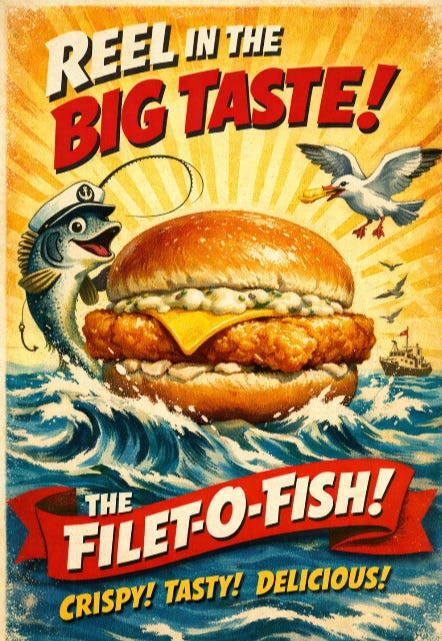
In 1962, a McDonald’s franchise owner named Lou Groen drove from Cincinnati to Chicago to tell Ray Kroc the menu needed a fish sandwich. Kroc did not want his stores smelling like fish. He proposed a competition instead: his own meatless Friday invention, the Hula Burger, against Groen’s Filet-O-Fish, head to head on Good Friday. The winner would earn a place on the permanent menu. The Hula Burger was a slice of grilled pineapple with cheese on a bun. The final score was Filet-O-Fish: 350, Hula Burger: 6. The market rendered a clear verdict, 58:1 for the fish burger.
Groen owned the 66th McDonald’s franchise ever opened, in Cincinnati. The neighborhood was 87 percent Catholic. On Fridays during Lent, his daily sales dropped to $75. He had a wife, twins at home, and a restaurant that was bleeding money one meatless Friday at a time. Across the street, the Big Boy restaurant was full every Friday because they served a fish sandwich. The problem was not subtle. His customers were not leaving because they disliked McDonald’s. They were leaving because their faith told them to skip meat on Fridays, and he had nothing else to offer them.
Groen spent months building his answer. He tested fish options (originally halibut), developed a batter that would work in the McDonald’s fryer, refined a tartar sauce from ingredients already on hand, and adjusted the bun so it would hold its texture. One afternoon he saw cheese added to a competitor’s fish sandwich and decided the idea was good enough to adopt. What he produced was not clever. It was correct.
Kroc, sitting in Chicago, saw the same data and reached a different conclusion. He reasoned that customers wanted something novel rather than something equivalent. His answer was the Hula Burger. The logic held together. The outcome did not. One customer who tried it reportedly said, “I like the hula, but where’s the burger?”
The distance between these two ideas is the distance between proximity and abstraction.
Groen was standing in his restaurant watching Catholic families walk past his door every Friday for six weeks of Lent. He could see the Big Boy across the street filling up. He did not have to infer what customers wanted because he could watch them choose it somewhere else. His solution was obvious because the evidence was overwhelming. A breaded fish fillet with tartar sauce satisfied the same hunger in the same way, without asking the customer to pretend novelty was a substitute for a meal.
Kroc was three hundred miles away, solving the problem the way headquarters often does. He started from the constraint and worked forward to something original. The conclusion had internal consistency and no contact with reality. More importantly, he had no one around him with the authority or guts to tell him so.
This is the pineapple problem. It shows up in every organization that reaches a certain size. The person closest to the customer has a simple, proven answer. The person farthest from the customer has a clever, untested one. The clever one gets attention because it is novel. The simple one gets dismissed because it is obvious. The result in this case was 350 to 6, and it was never in doubt.
The math of organizational distance is unforgiving. Every layer between decision-maker and customer increases the likelihood of solving the wrong problem. Groen had zero layers. His customers were his neighbors. When they stopped coming in on Fridays, he felt it immediately. Kroc had multiple layers: reports from the field, his interpretation of those reports, and the leap from interpretation to solution. Each layer introduced noise. By the time the signal reached Chicago, “Catholics need a Friday meal” had become “the menu needs a meatless novelty.”
The franchise model Kroc built was designed to prevent exactly this outcome. It assumes that operators with proximity and skin in the game will make better decisions than centralized authority. Groen was the system working as intended. Kroc overrode that system because he believed he had a better idea. The market corrected him.
The former CEO of an insurance company we represent had the brilliant idea to bring to market a life insurance product that would last for 100 years, reprice every five years, and carry no cash value. “Term to 100,” he called it, very proud of his marketing. “It’s a flop,” I told him. “People by permanent life insurance for its permanence, term for its cheap price. With this thing, you’re giving them neither.” He snuffed and double-down on the product, pushing it into the field with C-Suite vigor, marketing dollars we had asked for on profitable projects, and the quiet message that the Big Boss wanted this sold.
My agency didn’t touch it. It was junk, we knew it, and we don’t sell junk. The first year’s sales were 21% of projections. Going into the second year, the commission rate was increased so that brokers would sell more of it. It only underperformed by 54% because my competitors can be bought. 14 years after its launch, it finally outperformed greatly-lowed projections, because a client of ours insisted that it was the way to go, against our advice, and we gave them what they wanted.
Leaders repeat this pattern constantly. Someone close to the customer brings forward a solution grounded in real behavior, and it is rejected in favor of something more visionary. Vision matters. Vision without proximity produces pineapple on a bun. If a stranger told you what to name your child, you would dismiss him. In business, distance is often mistaken for perspective.
Today McDonald’s sells roughly 300 million Filet-O-Fish sandwiches a year, profit for the line is about $400 million). About twenty-three percent are sold during Lent, which means the seasonal problem Groen identified in 1962 still drives tens of millions of sales annually. Lou Groen retired in 1985 after owning 43 McDonald’s franchises. His granddaughter still operates the original location where it all began.
The lesson here is not that leaders should defer every decision downward. There is value in perspective from above the system. The lesson is that when someone standing inside the problem presents a working answer, the burden of proof shifts to the person who is not. Kroc had authority. Groen had proximity. Proximity won, and it was never close.
If you want to know whether your organization has the pineapple problem, ask a simple question: when was the last time someone closest to the customer proposed a solution and someone farthest from the customer overruled it? Then examine what followed. You may find you are still selling pineapple when the market is asking for fish.